In the power supply design, only in terms of PCB circuit board design:
1. First of all, there must be a reasonable direction
Such as input/output, AC/DC strong/weak signal, high frequency/low frequency high voltage/low voltage, etc. Their direction should be linear (or separated) and must not blend with each other. Its purpose is to prevent mutual interference. The best direction is a straight line, but it is generally not easy to achieve. The most unfavorable direction is a circle. Fortunately, isolation can be set to improve. For small DC signals, the requirements for low-voltage PCB circuit board design can be lower. So "reasonable" is relative.
2. Choose a good grounding point: the grounding point is often the most important
I don't know how many engineering and technical personnel have done a lot of discussion on the small grounding point, which shows its importance. Generally, a common ground is required, for example, multiple ground wires of the forward amplifier should be merged and then connected to the thousand-wire ground, etc. In reality, it is difficult to do it completely due to various restrictions, but it should be followed as much as possible. This problem is quite flexible in practice. Everyone has their own set of solutions. It is easy to understand if it can be explained for a specific circuit board.
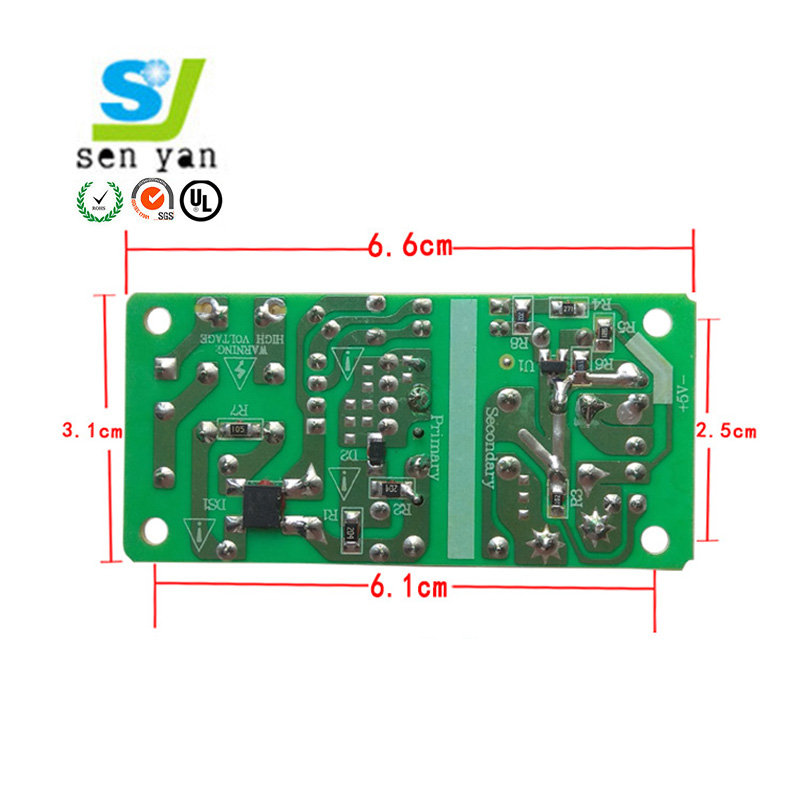
3. Reasonably arrange power filter/decoupling capacitors
Generally, only a few power filter/decoupling capacitors are drawn in the schematic diagram; but it is not indicated where they should be connected. In fact, these capacitors are set for switching devices (gate circuits) or other components that require filtering! Decoupling, these capacitors should be arranged as close as possible to these components, and it will be useless if they are too far away. Interestingly, when the power filter/decoupling capacitors are properly placed, the ground point problem is less obvious.
4. The line is exquisite, the wire diameter is required, and the size of the buried hole is appropriate
Lines that are conditionally wide must not be thin; high-voltage and high-frequency lines should be smooth, without sharp chamfers, and corners must not be at right angles. The ground wire should be as wide as possible, and it is best to use a large area of copper, which can greatly improve the problem of the grounding point. The size of the pad or via is too small or the size of the pad does not match the size of the drilled hole properly. The former is unfavorable to manual drilling, and the latter is unfavorable to CNC drilling. It is easy to drill the pads into a "c" shape and then drill out the pads. The wire is too thin; and there is no copper plating in the large-area final wiring area, which is likely to cause uneven corrosion. That is, when the unwired area is corroded, the thin wire is likely to be corroded too much, or it may be broken or completely broken. Therefore, the role of setting copper is not only to increase the ground area and anti-interference.
5. Number of vias, solder joints, line density
Although some problems occurred in the post-production, they were brought about by the design of the PCB circuit board. They are: too many wire holes, and a little careless copper sinking process will bury hidden dangers. Therefore, the number of wire holes should be minimized in the design. The density of parallel lines in the same direction is too high, and it is easy to connect together when welding. Therefore, the linear density should be determined according to the level of the welding process. If the distance between solder joints is too small, it is not conducive to manual welding, and the welding quality can only be solved by reducing work efficiency. Otherwise there will be hidden dangers. Therefore, the determination of the distance of solder joints should comprehensively consider the quality and work efficiency of welding personnel.